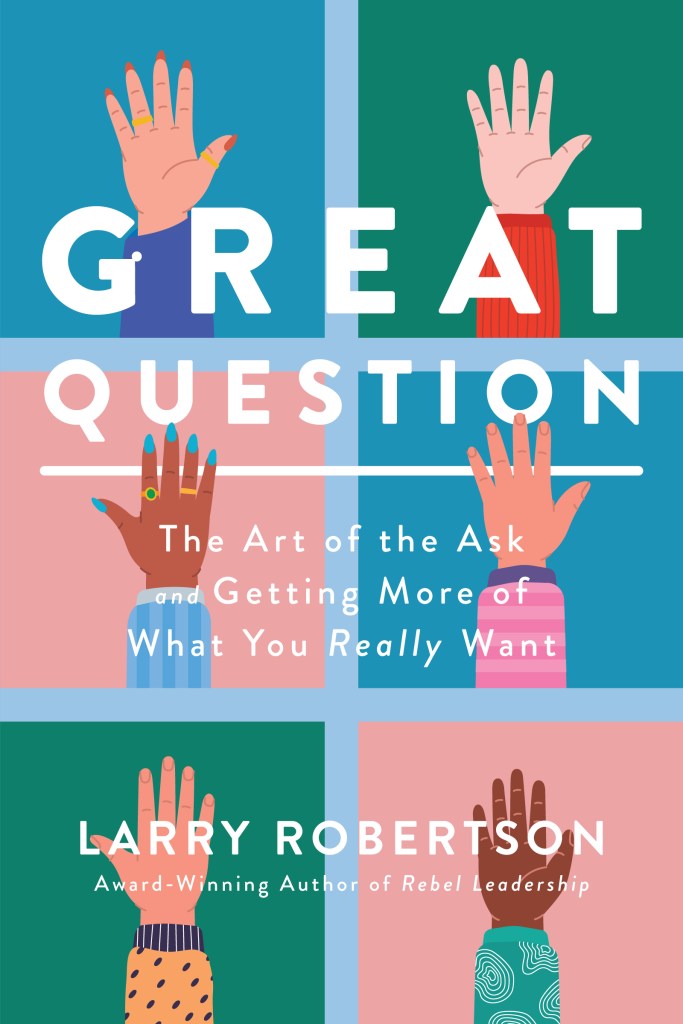
The Great Question Toolkit is an extension of the book Great Question: The Art of the Ask and Getting More of What You Really Want. Its purposes are kid-simple: to get you in the habit if asking; to increase the power of your asking, and learn from and connect to others doing the same. Enjoy! Share your ideas and thoughts! Connect! And, most of all – Ask!
Note: to learn more about Great Question, click here: lrspeaks
Suggested Articles
Reflection Might Be a Leader’s Greatest Asset
In World Peace, 3 questions matter more
Recommended Resources
Choose to Be Curious – Radio Show Episodes
Braver Angels: Courageous Citizenship Workshops
Books Worth Your Time
Great Question (truly, it is worthy)
The section above is simply to give you quick and current tastes of questioning in action. By no means are these the only resources, or even types of resources, you will find in this Toolkit. The sections below take you deeper into practice in the “art of the ask.”
The blocks of “tools” that follow are group by the 5 Elements that define the “art of the ask” from Great Question: Core, Context, Concession, Connection, and Continuation. The sections include a wide range of resources, from quick exercise, to entire methodologies. The way in which they are grouped by no means suggests that any tool is only useful to the Element in which it is referenced. Graze and experiment widely.
Tools for the Element of: Core
CORE Tool to Try (then see ‘More’ >)
Look Beyond Language for Questions. Samuel Ronfard suggested this, not so much as an exercise, but a fact.
A contributing factor to our lack of understanding of the power and importance of questions is that we most often look for them to appear as words, in a sentence written or spoken, ending in a question mark. But questions are all around us. They emerge from all our senses, and take many forms.
The exercise here is to consciously look for those ‘other forms’ of questions around you, to see how widely they are expressed, and how many more there are then what we most often note.
Click the link in the “More Core Tools” header for more tools.
More Core Tools (link)
Core Books:
A Whole New Mind, Dan Pink
The Undoing Project, Michael Lewis
Mindset, Carol Dweck
Core Stories:
Tools for the Element of: Context
CONTEXT Tool to Try (then see ‘More’ >)
Set Your Brain Up to Win. In Great Question, John Medina makes some remarkable observations about our brain and its need for questions. Among these are the following:
Your brain prefers to be in constant motion. It likes to be unrestricted, which means it prefers to be working in new zones, rather than those well worn grooves we figured out long ago. It likes to solve problems, but most of all, problems closer to the zone of survival, and especially doing so in environments of change, complexity, and uncertainty.
The exercise? Consciously take time to recall or to notice situations with these conditions you find yourself in. What do they look like for you? How do you find yourself there? How can you put yourself there … by choice.
Click the link in the “More Context Tools” header for more tools.
More Context (link)
Context Books:
See. Solve. Scale., Danny Warshay
Wanderful, David Pearl
I Never Thought of It That Way, Monica Guzman
Context Stories:
Want Long-term Success? Stop Talking About It and Start Measuring It
Tools for the Element of: Concession
CONCESSION Tool to Try (then see ‘More’ >)
Quiet Your Cleverness. Kaitlin Chuzi taught me this one, and uses it as her mantra. Like a mantra, the tool/exercise here is simple; it doesn’t ask much of you either. But when made a habit, is deeply powerful.
Bottom line, we think we know. And indeed we do know a lot. But the volume of what we don’t know is immensely greater than what we do.
Kaitlin’s reminder to herself is one I encourage you to play with. Start by just asking yourself to do this once. Then add reps. And be honest. No one has to know but you. When you do this, however, you start to tap the power of intellectual humility, concession, and your question asking.
Click the link in the “More Concession Tools” header for more tools.
More Concession (link)
Concession Books:
Critique Is Creative, Liz Lerman & John Borstel
The Tough Stuff, Cody Royle
Subtract, Leidy Klotz
Concession Stories:
Uncertainty is a pain. A lack of transparency makes it worse.
Tools for the Element of Connection
CONNECTION Tool to Try (then see ‘More’ >)
Allow Your Questions to Reflect Our Human Tendencies. Lynne Lawrence is a wise soul. More, she works each day on the foundation of more than 100 years of research and experimentation (the Montessori approach to teaching and learning) that tells a lot about who we are, and more, how we can access our best.
A central and consistent pattern in that research highlights these human tendencies: Humans tend to engage in exploration. We orient ourselves to explore. We strive to be independent, and also to seek out others. We want to communicate and express ourselves, to use our imagination and to develop capacities as we do. we are deeply curious and like new. Equally, we want to extract order, and more, meaning.
Here’s the exercise … Ask: Are you allowing these to guide you, or more often working to excuse yourself from them or around them?
Click the link in the “More Connection Tools” header for more tools.
More Connection (link)
Connection Books:
Creativity, Inc., Ed Catmull
The Insider’s Guide to Innovation @ Microsoft, Dean Carignan, JoAnn Garbin
The Idea Factory, John Gertner
Connection Stories:
Still questioning diversity? Maybe you’re asking the wrong question.
Tools for the Element of Continuation
CONTINUATION Tool to Try ( then see ‘More’ >)
Read a Human Book (or similar). Ronni Abergel is the founder of Human Library, an organization you’ll learn about in Great Question, and can learn about here.
There is much more to it, but Human Library allows you to get to know others and where they are coming from. Its set-up is that someone else is in the role of a “book” and you are the book’s “reader.” The agree to openly share with you what they know, and you agree to spark that by doing just three things – only three: Ask; Listen; and Ask some more.
Check out Human Library. But then check out its core suggestion, even if it’s on your own and by your own method.
Click the link in the “More Continuation Tools” for more tools.
More Continuation (link)
Continuation Books:
Whole Brain Living, Jill Bolte Taylor
Play, Stuart Brown
Wait, Frank Partnoy

